Soups
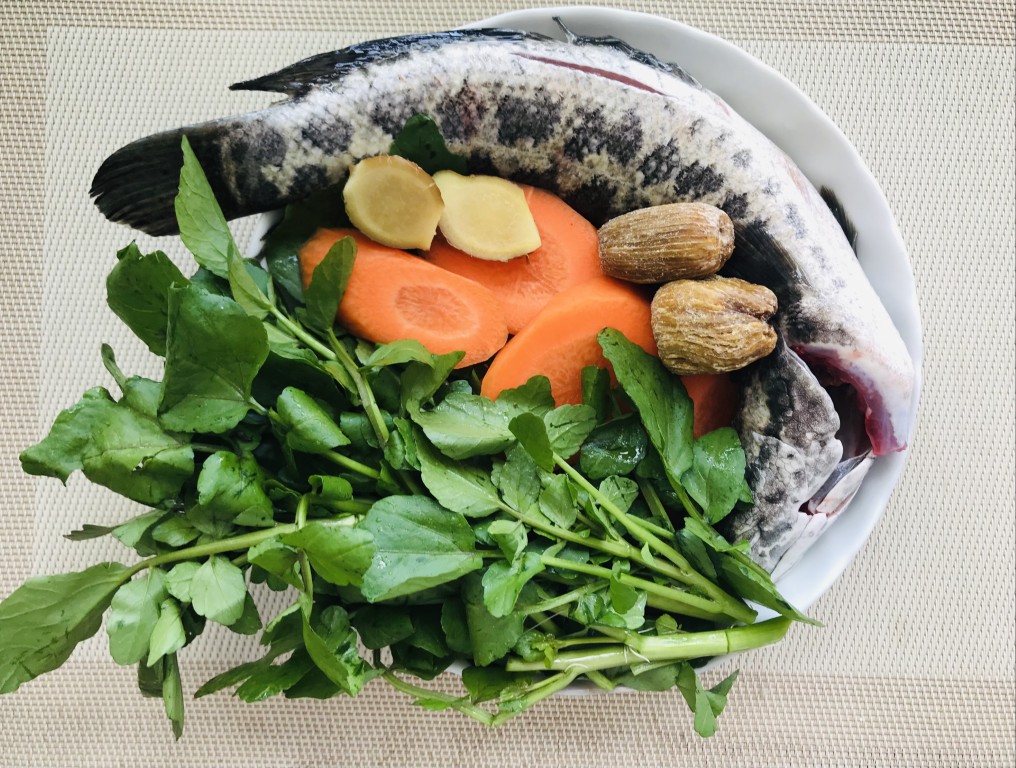
Chrysanthemum Greens (Tong Ho) and Fish Head Soup
traditionally used to warm the stomach, support digestion, and relieve cold-type nausea
In short: Chrysanthemum Greens (Tong Ho) and Fish Head Soup is a soup that traditionally used to warm the stomach, support digestion, and relieve cold-type nausea. It is most often made for respiratory & lung wellness, digestive wellness. Total time about 50 min. Key ingredients: large fish head, ginger, salt and seasoning.

Why people make this soup
Some people habitually drink large glasses of ice-cold drinks with every meal. Over time, this can deplete the warmth the digestive system needs to function well — in traditional Chinese medicine terms, cold contracts and obstructs, causing stomach qi to rebel upward rather than descend. The result: a dull, persistent ache in the stomach, a watery tastelessness in the mouth, little appetite, and occasional waves of nausea. This soup is a gentle, everyday response to that pattern.
Chrysanthemum greens (tong ho) have a distinctively fragrant, slightly warming character that is traditionally associated with settling the stomach. The fish head contributes a rich, nourishing broth and is considered in Chinese food therapy to support kidney and spleen function. Ginger and white pepper amplify the warming effect and help lift the fishy smell — the result is a beautifully flavoured, milky-white broth.
What studies say about the key ingredients
Traditional use is not the same as clinical proof. Here is the strongest human research we found for each ingredient, limitations included.
- Chrysanthemum
Compared with the high-fat meal alone, the extract group had lower postprandial glucose at 1 hour and higher antioxidant markers (T-AOC, SOD, GSH), with lower MDA. Incremental area under the curve did not differ significantly between groups.Limitation: Small sample of healthy young adults given a single high-fat meal, so longer-term effects and effects in people with metabolic conditions are unknown.PubMed 36677639 · 1 more chrysanthemum study - Ginger
Overall, acute and delayed nausea and vomiting did not differ significantly between ginger and control groups. A subgroup taking 1 g/day or less for over four days had less acute vomiting (OR 0.30).Limitation: Clinical heterogeneity between trials required subgroup analyses, and the authors state that sufficiently large, high-quality RCTs are still needed.PubMed 36501010 · 3 more ginger studies
From the Nourilo Research Library. Findings come from specific doses, extracts and populations and may not apply to a home-cooked recipe.
Safety first — read before you cook
This is a traditional food, not a treatment. Please check with your doctor or pharmacist before making it a regular part of your diet if you:
- are pregnant or breastfeeding, or are cooking for a young child;
- take regular medicines — especially blood thinners, blood-pressure, diabetes or immune-suppressing drugs;
- have a kidney, liver or heart condition, or a known food allergy.
Stop eating it and seek advice if you notice an allergic reaction or feel unwell. Safety notes reviewed 8 October 2026 · How we write safety notes
Members only
Unlock the full method & Nourilo's tips
One payment, lifetime access to every one of our 2,344 recipes — step-by-step methods, preparation tips and serving notes.
- Full step-by-step method for this and all 2,344 recipes
- Nourilo's Tips — sourcing, substitutions and serving notes
- One-time payment · card, Apple Pay or Google Pay · no subscription, no renewals
Checking your access…
$59.99 one-time · all recipes
Sign in or create a free account, then pay once by card, Apple Pay or Google Pay.
Continue with GoogleBy continuing with Google or email you confirm you are 16 or older and agree to our Terms of Use and Privacy Policy.
$59.99 one-time · all recipes
Signed in as ·
Secure checkout by Stripe. One-time payment, no renewals. Access is linked to your Nourilo account and never expires. By paying you agree to our Terms of Use; you can get a full refund within 14 days (refund policy).

Comments
Join the conversation — sign in or create a free account to comment.
Continue with GoogleBy continuing with Google or email you confirm you are 16 or older and agree to our Terms of Use and Privacy Policy.
Loading comments…