Home-Style Dishes
Braised Fish-Paste Stuffed Shiitake Mushrooms (Niang Dong Gu)
a light, savory everyday dish using fresh mushrooms and fish paste
In short: Braised Fish-Paste Stuffed Shiitake Mushrooms (Niang Dong Gu) is a home-style dishe that a light, savory everyday dish using fresh mushrooms and fish paste. It is most often made for everyday balance. Total time about 35 min. Key ingredients: shiitake mushrooms, ginger.

Why people make this dish
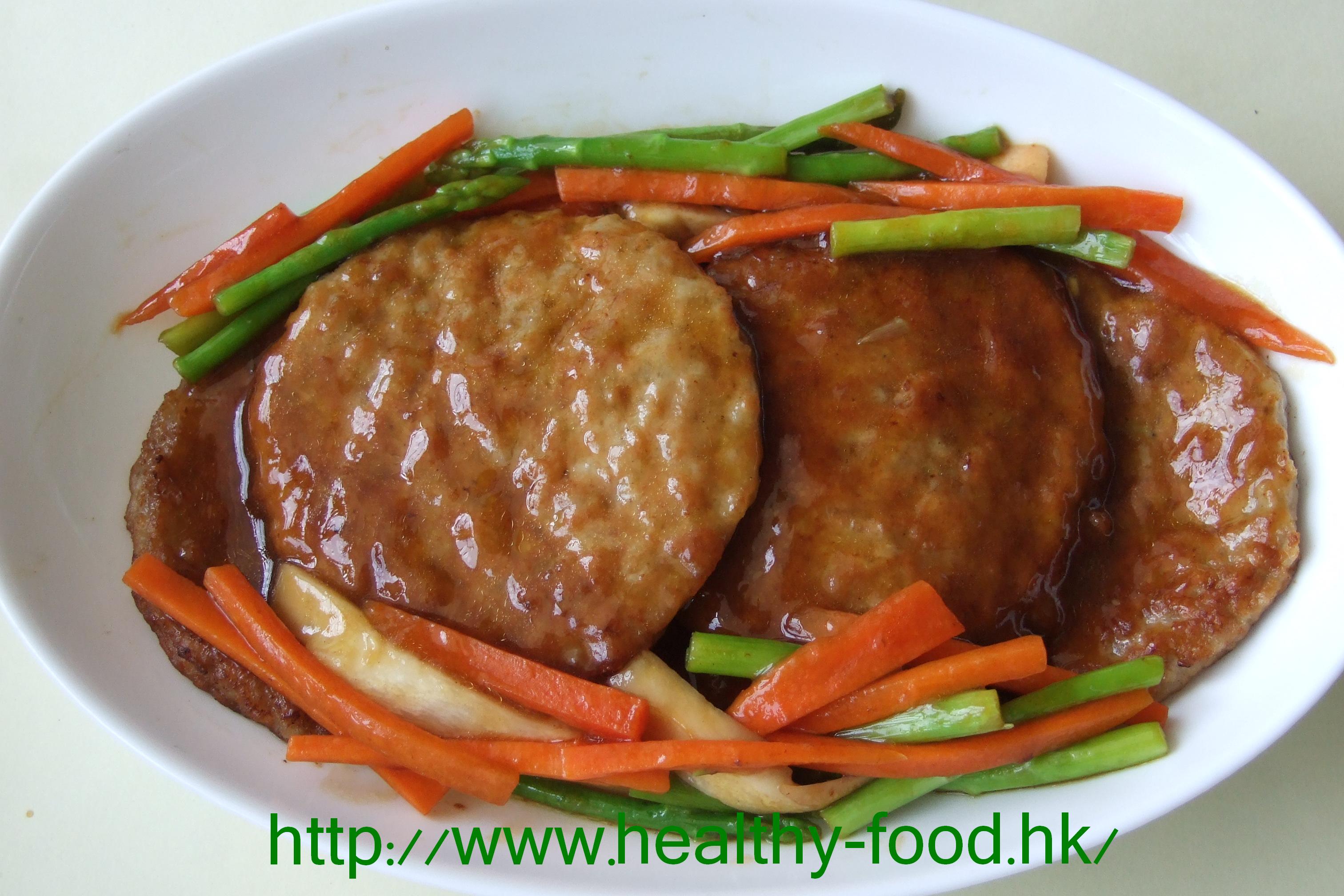
Nourilo enjoys cooking with fish paste (yu hua / dace paste) — it can be stuffed into green peppers, aubergine, tofu, or as here, fresh shiitake mushrooms. When he found a vendor at the market selling fish paste made from a type of carp (wu tou yu / mudfish), he bought some to try in this classic preparation: mushrooms are dusted with cornstarch on the inside, stuffed with the fish paste, pan-fried until golden on the bottom, then finished in a simple sauce. The result is tender mushrooms with a fragrant, savoury fish filling — a very easy dish that tastes far more refined than the effort involved.
Method
- Wash the lettuce and arrange on a serving plate; set aside.
- Remove stems from the shiitake mushrooms; wipe or gently rinse the caps. Pat dry.
- Dust the hollow inside of each mushroom cap with a light coating of cornstarch — this helps the fish paste stick.
- Press or spoon the fish paste firmly into each mushroom cap, mounding it slightly.
- Heat a flat-bottomed pan or wok over medium heat with a little oil. Place the stuffed mushrooms fish-paste-side down in the pan.
- Pan-fry until the fish paste is golden and cooked through, about 3–4 minutes. Remove and set aside.
- In the same pan, heat a little oil, add the minced ginger and stir briefly. Add half 300 ml of water and your seasoning (salt, light soy or oyster sauce). Bring to a simmer.
- Return the mushrooms and a few lettuce leaves to the pan. Let the liquid reduce for 1–2 minutes until the sauce is slightly thickened and coats the mushrooms.
- Transfer to the prepared serving plate and serve immediately.
Nourilo’s Tips
- For the best flavour and texture with dried shiitake mushrooms (if using those instead of fresh), soak them until fully softened, then steam them briefly with a little oil and sugar before stuffing — this gives a much more fragrant, silky texture than just soaking.
- Fresh shiitake mushrooms are lighter and more tender than dried; they work beautifully in this quick braised preparation.
- If fish paste is not available at your local fishmonger, a good-quality store-bought fish ball paste or minced fish with seasoning makes a decent substitute.
- The garnishing vegetables can be whatever you have: bok choy, gai lan, spinach, or any leafy green.
What studies say about the key ingredients
Traditional use is not the same as clinical proof. Here is the strongest human research we found for each ingredient, limitations included.
- Shiitake mushrooms
Daily shiitake intake was associated with increased ex vivo proliferation of γδ-T and NK-T cells, higher salivary sIgA and lower serum CRP, along with changes in cytokine patterns. The comparison was before versus after intake in two dose groups.Limitation: Parallel 5 g and 10 g dose groups with no placebo or non-mushroom control. Short 4-week study in healthy young adults, with mostly ex vivo immune markers.PubMed 25866155 · 2 more shiitake mushrooms studies - Ginger
Overall, acute and delayed nausea and vomiting did not differ significantly between ginger and control groups. A subgroup taking 1 g/day or less for over four days had less acute vomiting (OR 0.30).Limitation: Clinical heterogeneity between trials required subgroup analyses, and the authors state that sufficiently large, high-quality RCTs are still needed.PubMed 36501010 · 3 more ginger studies
From the Nourilo Research Library. Findings come from specific doses, extracts and populations and may not apply to a home-cooked recipe.
Safety first — read before you cook
This is a traditional food, not a treatment. Please check with your doctor or pharmacist before making it a regular part of your diet if you:
- are pregnant or breastfeeding, or are cooking for a young child;
- take regular medicines — especially blood thinners, blood-pressure, diabetes or immune-suppressing drugs;
- have a kidney, liver or heart condition, or a known food allergy.
Stop eating it and seek advice if you notice an allergic reaction or feel unwell. Safety notes reviewed 8 October 2026 · How we write safety notes


Comments
Join the conversation — sign in or create a free account to comment.
Continue with GoogleBy continuing with Google or email you confirm you are 16 or older and agree to our Terms of Use and Privacy Policy.
Loading comments…